And The New Model Starts With Architectural Truth
AI can now generate more software in a week than most teams produce in a quarter. But the real shift isn’t in writing code. It’s in who defines correctness, and who enforces it.
The architect becomes the source of truth. The CI/CD pipeline becomes the enforcement engine. AI becomes the implementation engine.
This is the new model of delivery.
1. AI output explodes. Human validation collapses.
The first time AI starts generating twenty or thirty PRs before lunch, you think it’s a breakthrough. The second time, you start seeing queues. The third time, you realise your entire validation model has collapsed.
And the moment you sketch it out, the bottleneck becomes obvious.
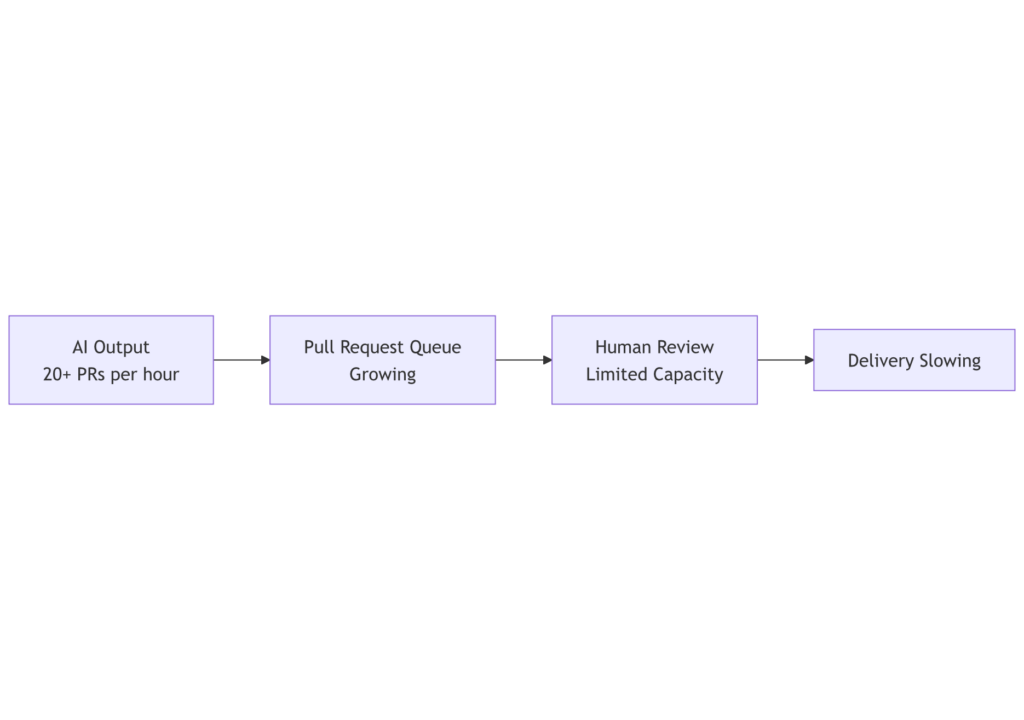
This is where manual review dies. AI accelerates creation. Humans throttle throughput.
2. Architects stop inspecting code and start defining the truth
This is the shift most organisations are missing.
When AI writes 80 percent of the implementation, architects don’t review diffs. They define the rules the system must always follow.
They set:
- domain rules
- data integrity requirements
- NFRs
- architectural principles
- guardrails
- API and event contracts
- state transitions
- cross-country behaviour
- operational guarantees
- performance and scaling expectations
- what must always remain true
This has to be written down. Not implied. Not tribal. Documented in repositories the agents and engineers can consume.
And when you map that moment, the role becomes clear.
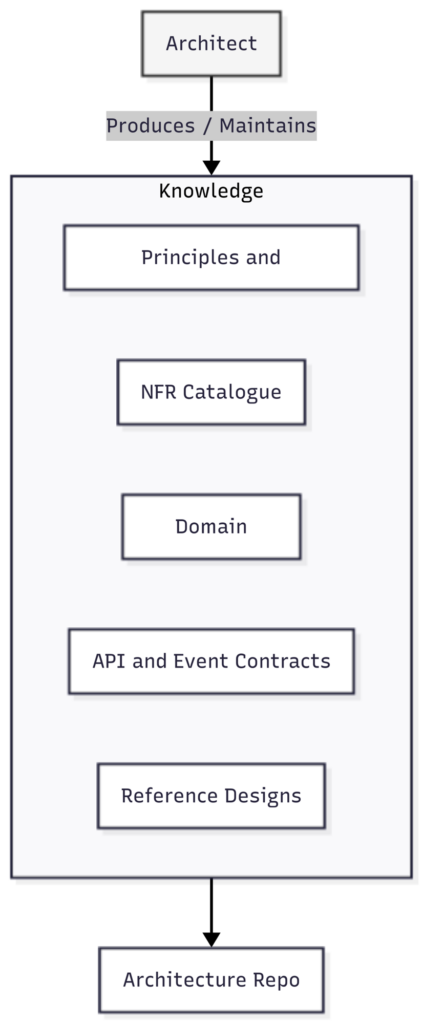
Architects define the truth. Everything else aligns to it.
3. The team and AI build against the standards the architect provides
The architect doesn’t publish PDFs into the void. They feed the team directly. They explain the rules. They shape the shared understanding.
This is the foundation AI needs. When the rules are clear, the implementation stays inside the boundaries.
And the flow looks like this:

The architect enables the team. Not by reviewing code, but by defining clarity.
4. Spec driven development is the missing link
Even with clear rules and guardrails, something is still missing.
To make AI-driven delivery work, you need something concrete that both AI and CI can read.
That is where spec driven development comes in.
Spec driven development means architecture produces a machine readable source of truth that sits between people, AI and automation.
It is the single, authoritative definition of what the system is allowed to do.
And it goes far beyond architecture diagrams. A real spec includes:
- domain rules and invariants
- lifecycle and state transitions
- NFRs
- guardrails and constraints
- API and event contracts
- functional requirements
- acceptance criteria (ACs)
- expected behaviours and edge cases
In other words:
everything needed for an AI agent to generate correct behaviour, and everything needed for CI/CD agents to validate it.
Architects and product work together to produce this spec.
Architecture provides the rules, constraints and boundaries.
Product provides the outcomes, functional capabilities and ACs.
The spec merges these into one enforceable truth model.
AI agents read the spec when generating designs, tests and code.
Engineers use it to reason about changes without guessing.
CI/CD agents use it to decide if behaviour matches what was promised.
The spec becomes the centre of gravity for the entire delivery model.
Engineers read it when reasoning about the system.
The spec becomes the centre of gravity.

The specification becomes the API of architecture.
AI becomes the implementation layer.
CI/CD becomes the enforcement layer.
And because ACs and functional requirements are part of that spec, they finally become first-class citizens in the validation process rather than tickets that drift into the void.
Spec vs requirements vs documentation
Most organisations think they have specifications, but what they have is requirements and documentation.
Here is the actual difference:
Requirements
Human friendly. Useful for conversation. Too vague for AI or CI/CD to enforce.
Documentation
Describes how things work today. Often out of date the moment it’s written.
Specification
Machine readable. Precise. Enforceable.
Includes rules, NFRs, ACs, functional requirements, events, contracts and constraints.
Requirements help humans think.
Documentation helps humans remember.
The spec is what AI and CI/CD use to decide what is allowed.
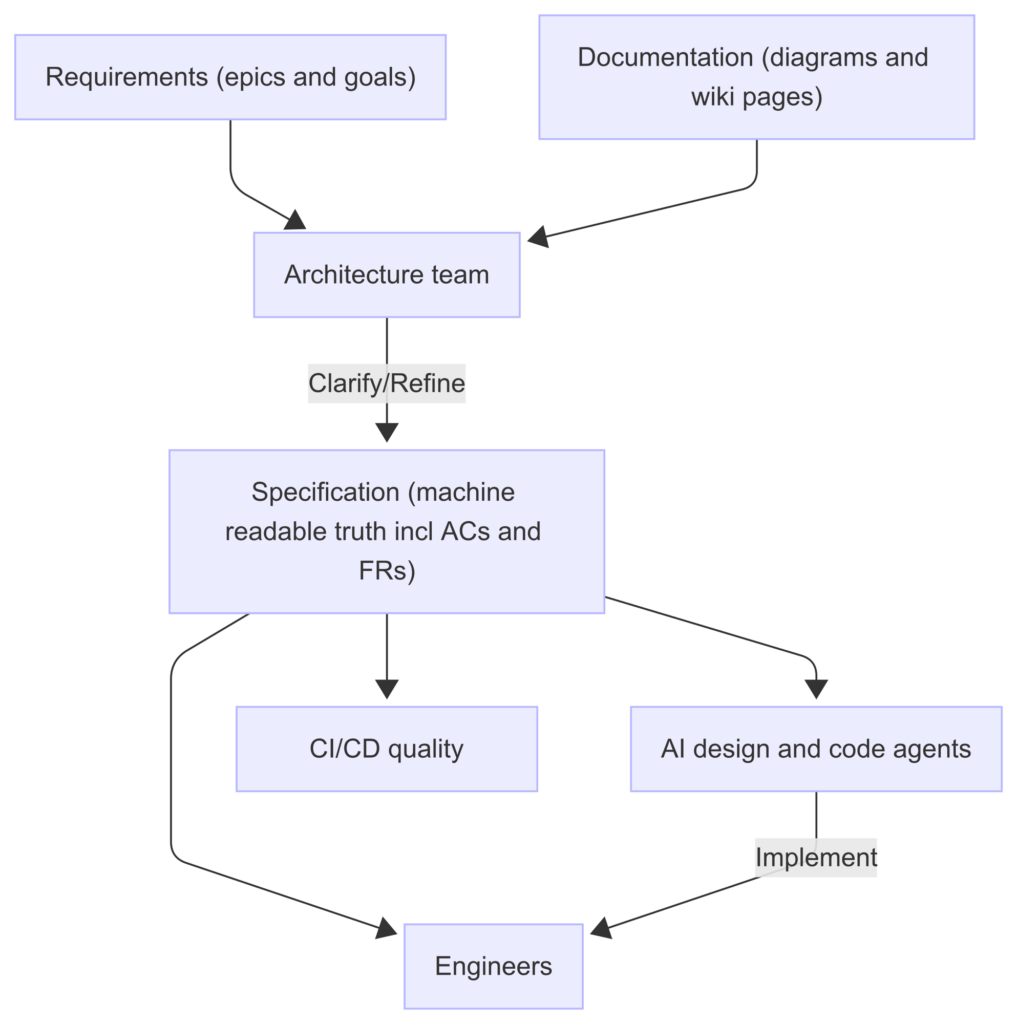
Without a spec, AI guesses and CI/CD cannot enforce anything meaningful.
With a spec, the system gains consistency, correctness and scale.
5. CI/CD becomes a network of agents enforcing architectural truth
This is the real turning point in modern engineering.
Once the truth is defined, it must be enforced. Not by humans. Not by ceremonies. By agents inside your CI/CD pipeline.
These agents read from two places:
- the Architecture Repo for global standards, guardrails and rules
- the Service Repo for local behaviour and context
They validate:
- guardrails
- NFR compliance
- contract correctness
- lifecycle integrity
- security posture
- event sequencing
- performance budgets
- coding standards
- basic PR quality
This is the new review process.
The diagram makes the shift obvious.

Your pipeline becomes the reviewer. Your agents become the gatekeepers
6. When something breaks, AI regenerates until it aligns with the rules
Human patching is too slow. When an agent detects a violation, AI regenerates the implementation until it matches the rules.
This is where the delivery loop becomes self-correcting.

You don’t fix failing code. You fix the rules. The system fixes the code.
7. The new operating model becomes unavoidable
This is the architecture of AI-first delivery. The moment you draw it, the future becomes obvious.

Architects define. AI builds. Agents enforce. Delivery accelerates.
Final point
If your answer to AI-generated code is to review every line, you have missed the shift completely.
The bottleneck was never coding. It was manual review, vague requirements, drifting documentation and pipelines that only check syntax. AI simply accelerates how quickly you collide with all of them.
The only way forward is to define the truth up front.
Rules, NFRs, contracts, acceptance criteria and functional behaviour must be captured as a machine readable spec that AI can build from and CI/CD agents can enforce.
AI generates the implementation.
Agents validate the behaviour.
Regeneration replaces rework.
Correctness becomes automatic.
Teams that adopt this model will deliver at machine speed with real control. Teams that cling to human-paced review will never see the benefit of AI at all.
It starts with the architect defining the spec.